Bunky - The College Roommate Matching Platform
Position
Design Product Manager
Timeline
January 2026 - May 2026
Skills
Agile
UX Research
Design Consulting
Product Management
Design Specs
Tools
Figma
FigJam
Notion
01 Overview
02 Process
03 Takeaways
01 | Overview
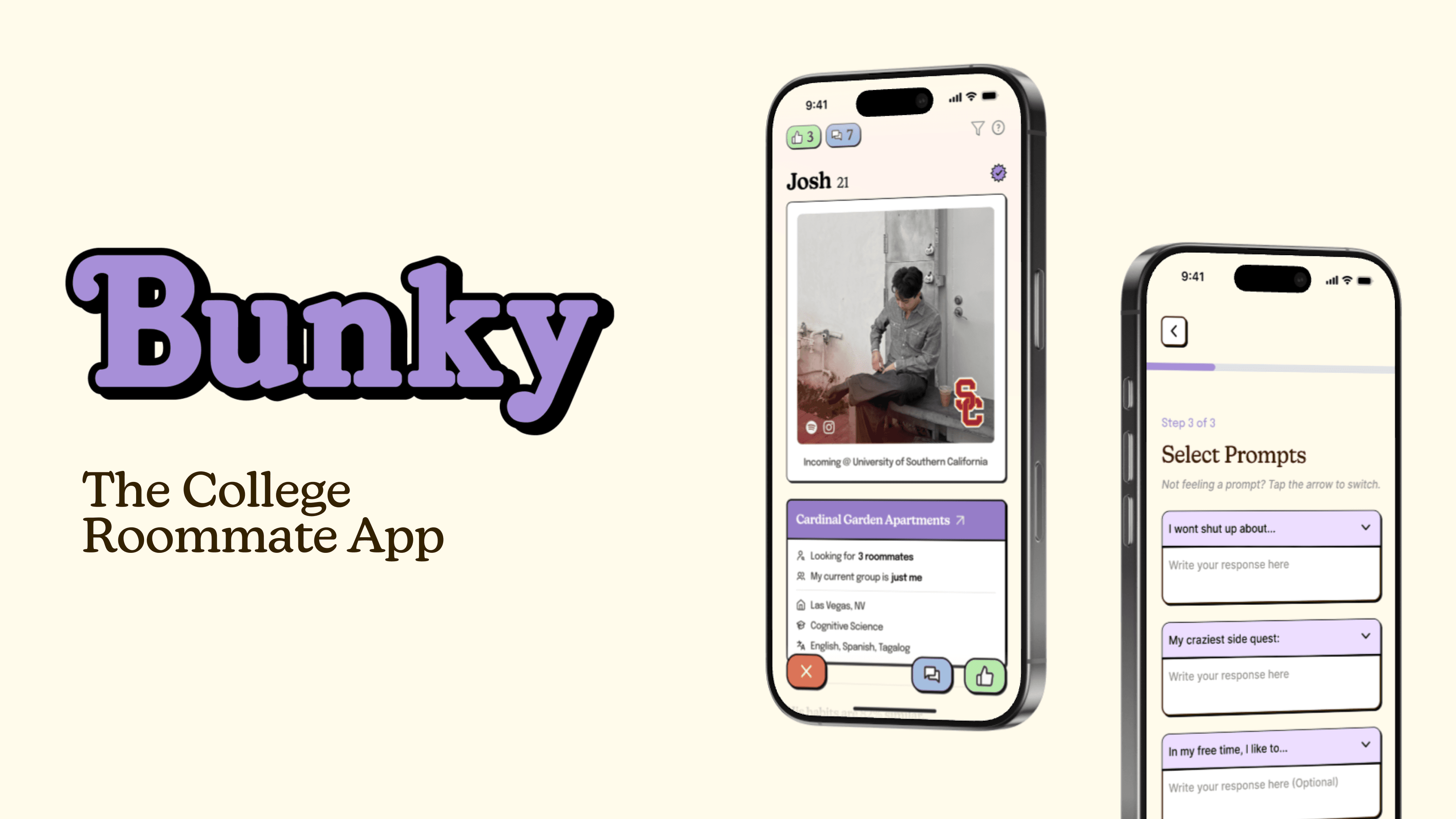
Bunky is a college roommate-matching app built around personality, connecting students based on lifestyle, habits, and vibe. In Spring 2026, Innovative Design, a creative service agency at USC, was brought on to conduct a comprehensive UX audit and deliver production-ready design assets and consulting. As the Product Manager, I led a team of four designers across a five-sprint engagement, translating Bunky’s business goals into an actionable design roadmap and owning delivery from discovery to handoff.
The Problem
Bunky had strong product-market fit with college students, but three friction points were holding back growth and user clarity:
Monetization gap — Bunky Pro lacked visual affordance across the platform, making it hard to drive subscription conversions without disrupting the core experience
Matchmaking confusion — Users struggled to understand the relationship between likes, chats, and Pro-gated features, creating drop-off in key activation flows
Visual inconsistency — Design decisions weren’t systematized, causing brand fragmentation and slowing the pace of future development
My job as PM was to turn these three loosely defined pain points into a structured scope with clear priorities, timelines, and success criteria and keep the team aligned to that scope across the full semester.
02 | Process
Coming into this as a student PM, I knew the work would require more than just running meetings. The real challenge was learning how to operate as the middleman between the client (Bunky) and a creative team with different working styles.
Sprint scoping and prioritization. I broke the project into five focused sprints, each with explicit goals, deliverable scope, and a clear “why now.” Getting the sequencing right early meant the team wasn’t constantly blocked or backtracking.
Stakeholder management. I ran weekly check-ins with the Bunky team throughout the engagement. This meant prepping agendas, synthesizing designer output into digestible updates, fielding feedback, and translating that feedback back into actionable direction for the team. Learning to manage up to a client while also managing the team’s bandwidth was one of the steepest growth curves for me on this project.
Defining the P0s. Early in the discovery sprint, I worked with Bunky to identify which problems were truly blocking and which were nice-to-haves. Scoping a semester-long engagement for a team of four required hard prioritization calls and admitting that we couldn’t solve everything, so we had to be deliberate about what would drive the most product impact.
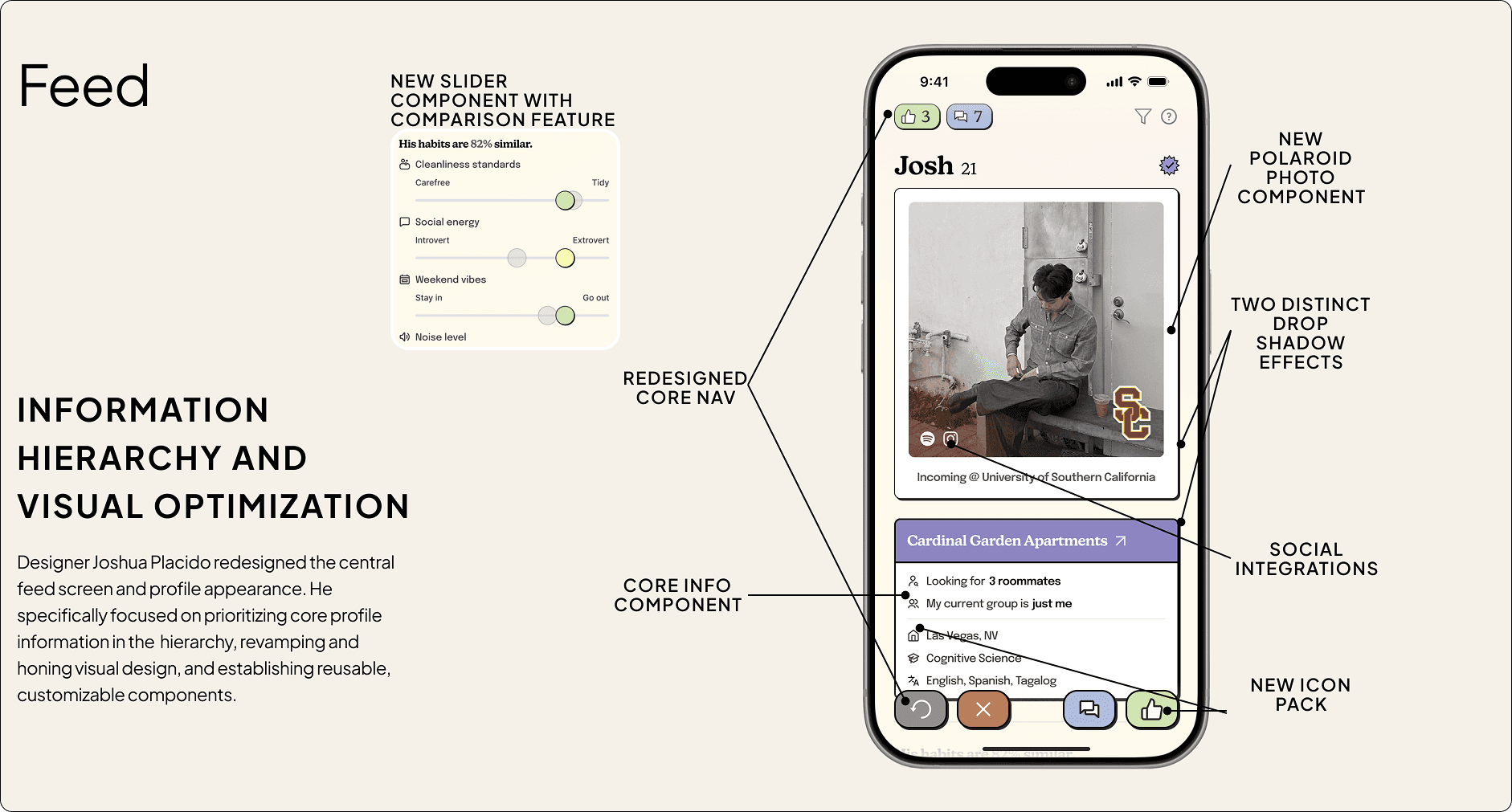
Handoff quality. The final sprint was dedicated to Design Spec documents for every major screen (Feed, Profile, Onboarding, Chat, Getting Started). I held the bar on these because sloppy handoffs kill otherwise great design work. The specs needed to be detailed enough that an engineer could implement without follow-up questions, especially considering the Bunky team’s current size.
Sprint Design
The team followed an agile four-step framework applied iteratively across sprints:
Discover — Audited existing flows, benchmarked competitor apps, and met with the Bunky team to surface opportunities
Define — Narrowed each sprint’s focus to a specific problem area and established success metrics
Design — Produced wireframes and high-fidelity mockups, iterating weekly with client feedback
Deliver — Handed off production-ready assets with annotations and collected feedback for the next sprint
Sprint | Focus | Deliverables |
|---|---|---|
1 | Discovery and Visual Foundations | UX Audit, Moodboards, Initial Prototypes |
2 | Design System | Full Figma Component and Style Library |
3 | Prototyping | Lofi + Hifi Prototypes (Feed, Profile, Onboarding, Chat) |
4 | UX Copy | Rewritten Copy, Bunky Pro Feature Development |
5 | Ship and Revise | Design Spec Docs, Final Presentation Deck |
Design Insights
While I wasn’t directly producing designs, I stayed closely involved in design decisions to make sure they connected back to the product goals — not just visual quality.
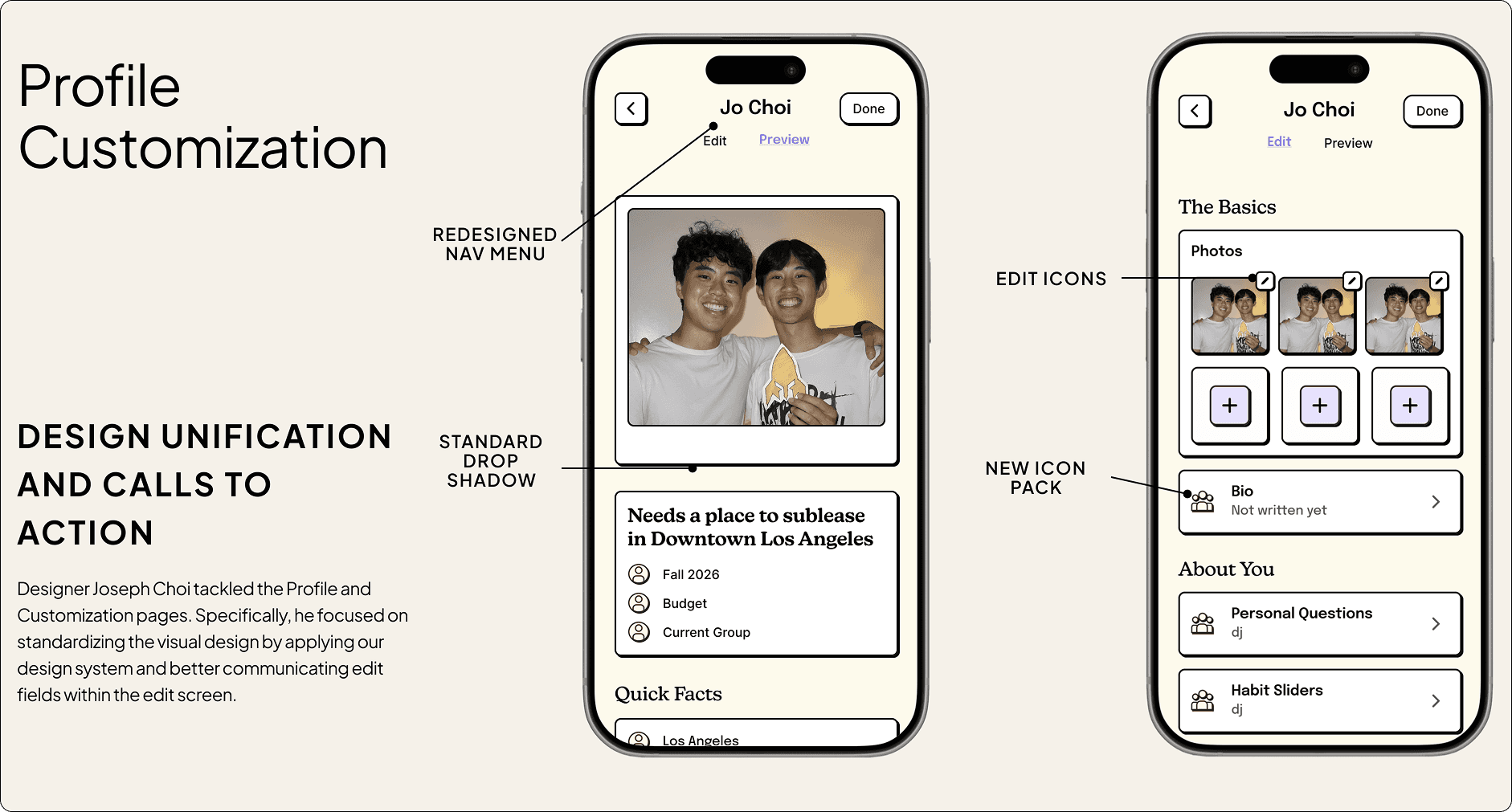
Building the design system first was a strategic call. Sprint 2 was entirely dedicated to constructing a Figma design system before any screen-level work happened. This meant establishing a 4pt spacing scale, locking in typography (New Kansas for headers, Epilogue for body), defining the color palette, and building reusable components for navigation, cards, forms, modals, and buttons. Our design system enabled the prototyping sprint to move faster because designers weren’t making style decisions from scratch on every screen.
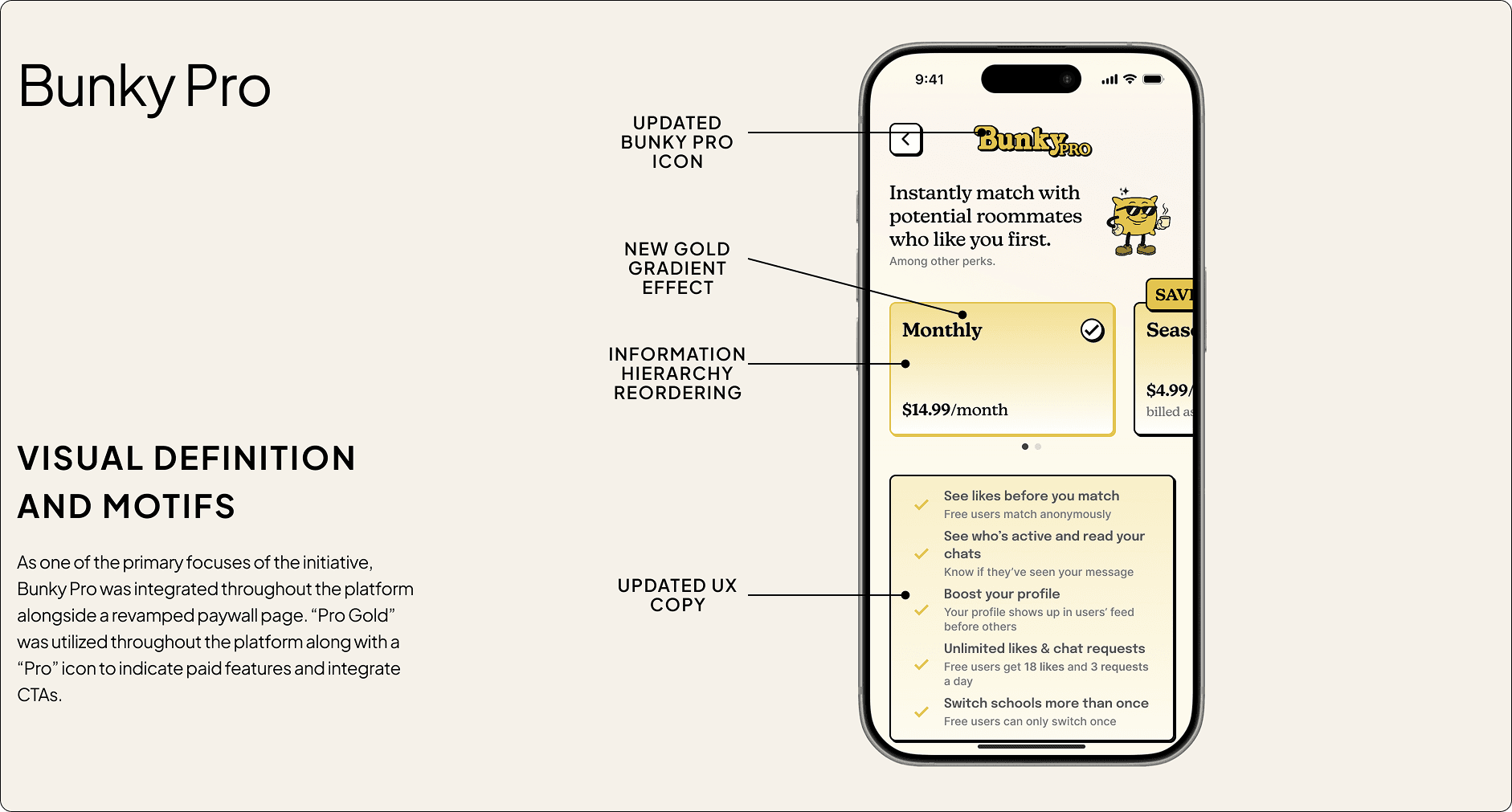
Monetization-driven design, not just aesthetic redesign. One of the things I pushed the team on was framing Bunky Pro as a product problem, not just a visual one. The solution wasn’t just a prettier paywall, it was weaving Pro visibility throughout the app through a “Pro Gold” gradient motif, a persistent Pro icon on gated features, and strategic CTAs in the Chat screen (blurred profile image with a likes count reveal). The goal was organic conversion, not forced interruption.
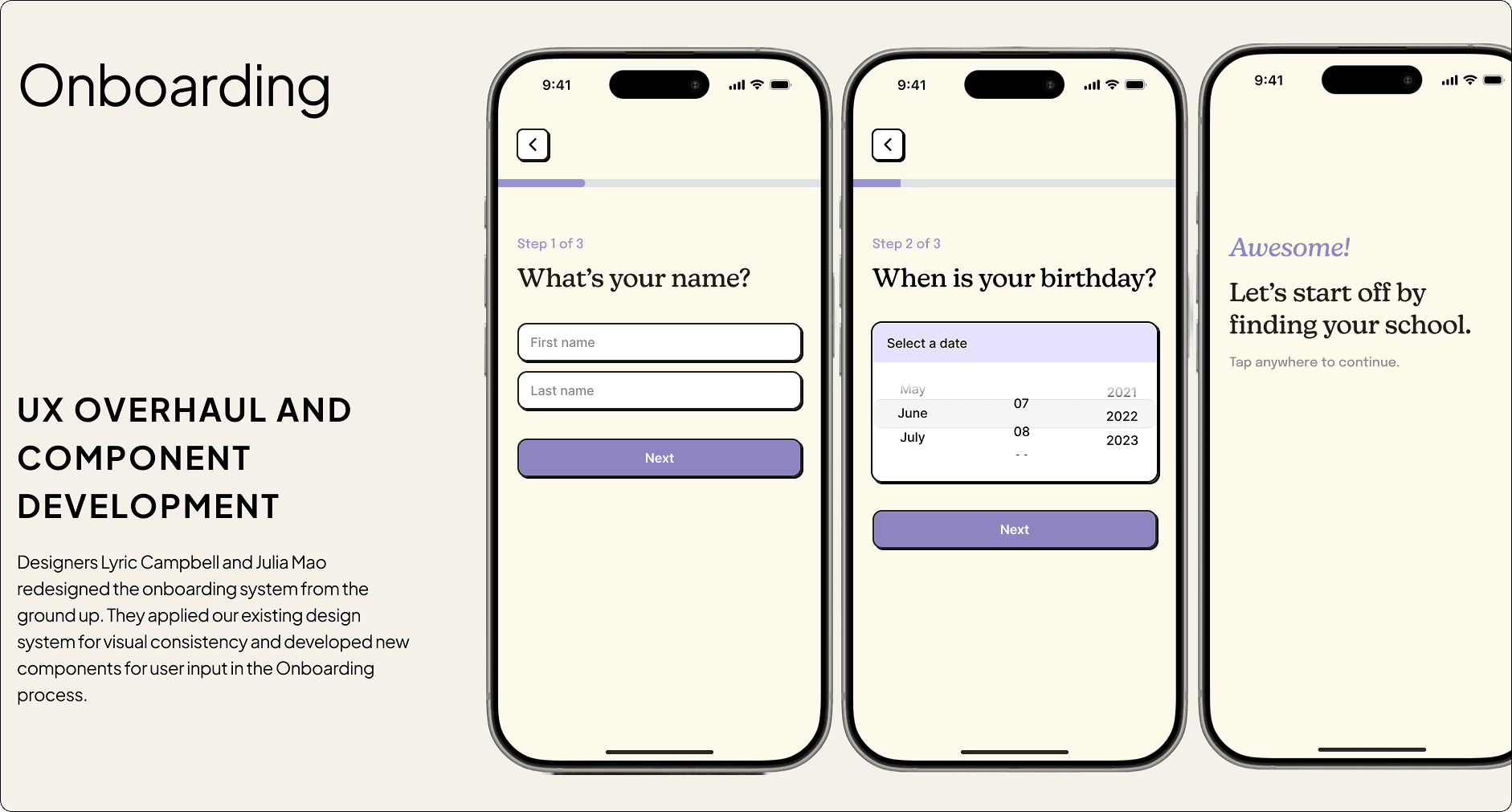
Onboarding as an activation lever. The onboarding flow got a full redesign, with new input components (sliders, prompt blocks, pill inputs) and rewritten UX copy to reduce friction and better communicate Bunky’s core value proposition. Earlier in the funnel is always where drop-off hurts most, so this felt like one of the higher-leverage bets we made.
03 | Takeaways
Coming from an experience designing/building from zero, this project taught me how to build on an existing brand and satisfy client needs. A few specific things I took away:
Framing problems in business terms sharpens creative output. When I positioned design challenges as conversion problems or activation problems rather than just UI problems, the team’s solutions became more focused and more defensible to the client.
Sequencing work is as important as defining work. A lot of PM skill is understanding what needs to happen before something else can happen. Getting the sprint order right — audit → system → prototype → copy → handoff — made the whole engagement feel coherent rather than scattered.
Stakeholder alignment is an ongoing job, not a kickoff deliverable. Weekly check-ins with Bunky weren’t just status updates — they were the mechanism for catching misalignment early before it became expensive to fix. I got a lot better at facilitating those conversations over the course of the semester.
Reflection
“Bunky’s strengths lie in its ability to welcome college students and their creativity, building real connection. Our goal was to optimize this experience through deep user empathy and design expertise to define a consistent visual design language for Bunky.”
Looking back, the most valuable part of this project wasn’t any single deliverable, it was learning how to lead. Managing a creative team, maintaining client trust, and shipping polished work on a fixed timeline is exactly the kind of pressure I want to keep putting myself in. This project gave me real confidence that I can do the PM work, not just in theory, but for an actual product with real users.